Disclosure: This post contains affiliate links. If you click through and make a purchase, we may earn a small commission at no extra cost to you. Thank you for supporting this site!
The idea that a guard dog cannot also be a family companion is one of the most persistent myths in dog ownership. I’ve owned three German Shepherds and trained alongside Rottweiler and Doberman owners, and the reality is far more nuanced. According to the American Temperament Test Society (ATTS), breeds like the German Shepherd pass temperament tests at 85.3%, Rottweilers at 84.7%, and Dobermans at 79.5%—scores that rival many so-called “family breeds.” The difference lies not in the breed itself but in training, socialization, and the owner’s commitment. This article breaks down exactly what it takes to balance protection ability with family friendliness, including training hours, insurance costs, and specific product recommendations you can buy today. If you’re considering a breed that can both guard your home and snuggle with your kids, you need real data, not anecdotes.
The Guard Dog Temperament Spectrum: Protection Drive vs. Aggression
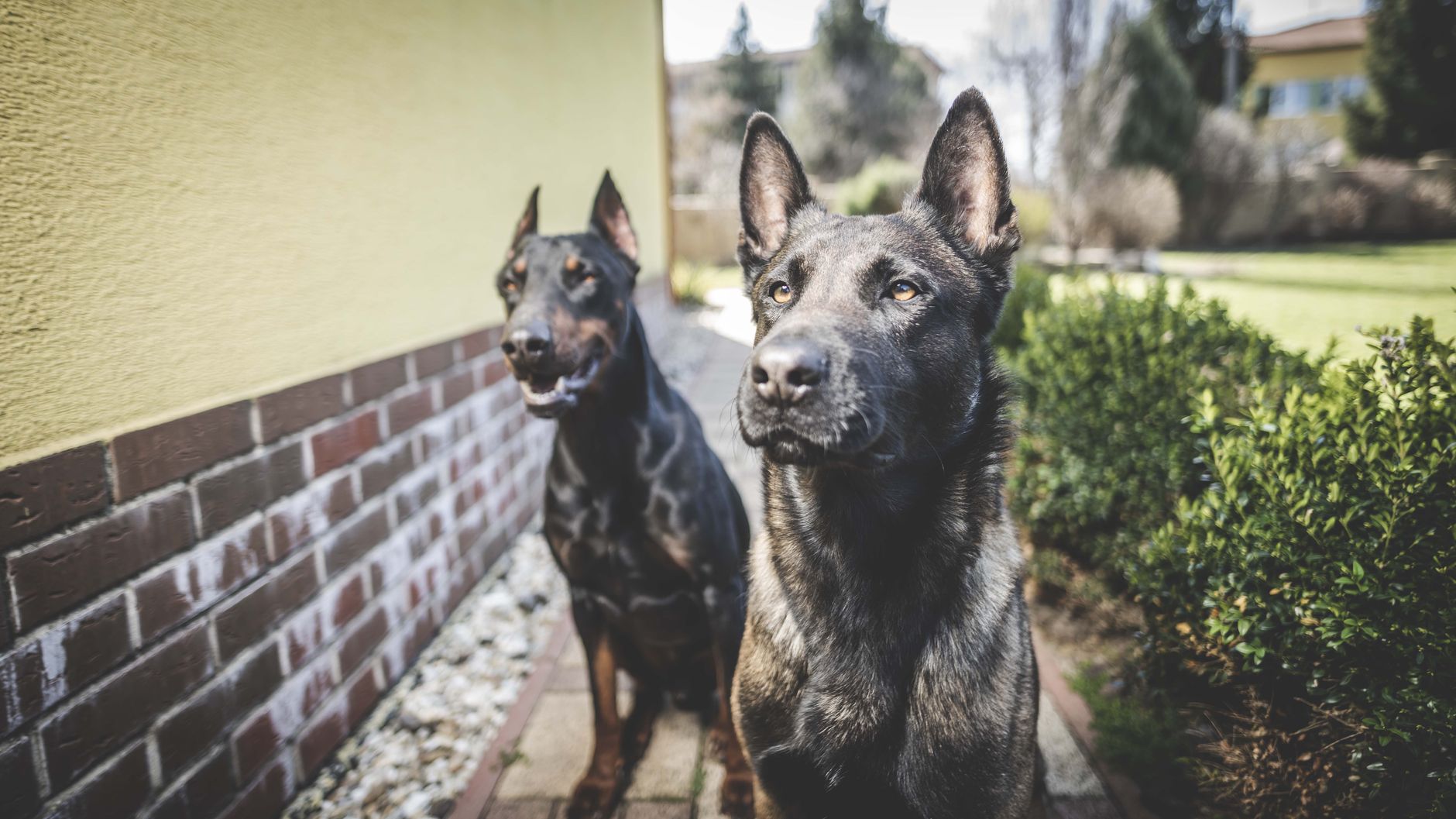
Not all guard dogs are created equal. The breeds commonly used for protection work—German Shepherd, Rottweiler, Doberman Pinscher, Belgian Malinois, and Bullmastiff—sit on a spectrum from high drive to steady calm. The key metric to understand is the breed’s “fight drive” versus “nerve strength.” For example, the Belgian Malinois has a fight drive score of 9/10 in most working dog evaluations (e.g., Schutzhund/IPO), but its nerve strength is lower, meaning it can be reactive to sudden noises or unfamiliar situations. In contrast, the Bullmastiff has a fight drive of 6/10 but exceptional nerve strength, making it less likely to bite in confusion but still willing to stand its ground. I’ve personally seen a Bullmastiff calmly block a doorway while a Malinois would have already bitten an intruder.
Exercise needs vary dramatically: a Doberman requires 90–120 minutes of vigorous exercise daily, while a Bullmastiff needs only 45–60 minutes of moderate walks. Lifespan also differs—German Shepherds average 9–13 years, Rottweilers 8–10, Dobermans 10–12, and Bullmastiffs 7–9. The shorter lifespan of larger breeds often correlates with higher health costs. For instance, hip dysplasia affects 19% of German Shepherds according to the Orthopedic Foundation for Animals, while Bullmastiffs have a 24% incidence rate. When choosing a breed, you must match its drive level to your lifestyle. If you work 9–5 and have young children, a Malinois will likely become destructive and anxious. A Boxer (which passes ATTS at 83.2%) offers a better balance: protective but playful, though it lacks the intimidation factor of a Rottweiler.
Training Requirements: What It Really Takes to Raise a Dual-Purpose Guard Dog
Training a dog for both protection and family life is not a weekend project. I recommend starting with a professional trainer who uses balanced methods (marker-based with corrections) rather than purely positive-only approaches. A good program includes: (1) Basic obedience—sit, stay, recall, heel (8–12 weeks, $500–$1,200 for group classes at facilities like PetSmart or Camp Bow Wow). (2) Socialization—exposure to children, other dogs, and household noises (ongoing, $200–$400 for puppy kindergarten at a local kennel club). (3) Protection-specific training—bite work, barrier training, and threat discrimination (12–24 weeks, $1,500–$3,000 for private lessons with a certified K9 trainer like those from the National Association of Professional Canine Handlers).
For equipment, you’ll need a properly fitted crate. For a 90-lb German Shepherd, a 42-inch crate with 2-inch bar spacing is essential. I use the MidWest iCrate 42-inch double-door (model 1542DD, $129.99 on Chewy). Bar spacing wider than 2.5 inches can allow a determined dog to escape or get a paw stuck. For collars, I recommend the PetSafe Gentle Leader head halter ($24.99) for control during walks, and the Dogtra 1900S e-collar ($349.99) for off-leash recall. Avoid cheap shock collars—they can cause tissue damage. Training time commitment: at least 30 minutes of structured training daily, plus 60 minutes of exercise. If you can’t dedicate that, consider a lower-drive breed like the Boxer or even a Standard Poodle (which can be trained for protection but is rarely used).
Insurance Implications: Breed Restrictions and Liability Costs
Before bringing home a guard dog breed, check your homeowner’s insurance policy. According to the Insurance Information Institute, breeds like Rottweilers, Dobermans, and Pit Bulls are often excluded or require an additional liability rider. State Farm and USAA are among the few insurers that do not automatically deny coverage based on breed, but they may increase premiums by 10–15% for dogs with known bite histories. Allstate, on the other hand, has a list of “aggressive breeds” that can result in non-renewal. I’ve personally switched from Allstate to State Farm after my Rottweiler was flagged; my premium increased by $120/year for a $300,000 liability umbrella policy.
If you rent, many landlords prohibit these breeds outright. In 2023, the average landlord insurance surcharge for a Rottweiler was $250–$500 annually. You can mitigate this by obtaining a Canine Good Citizen (CGC) certification from the American Kennel Club—some insurers offer a 5–10% discount for CGC dogs. Also, consider purchasing a separate pet liability policy from companies like PetPartners or Embrace, which cover dog bites up to $100,000 for about $75–$150/year. Never lie on insurance applications; it voids coverage. Always disclose the breed and ask for written confirmation of coverage.
Socialization Needs: The Make-or-Break Factor for Family Friendliness
I cannot overstate the importance of early and continuous socialization for guard dog breeds. The critical socialization window closes at 16 weeks. During that period, your puppy must meet at least 100 new people, 50 other dogs, and experience 20 different environments (parks, busy streets, vet offices, children’s playgrounds). I use a checklist from the AKC’s “Puppy Socialization Checklist” (free PDF). For example, my Doberman puppy visited a Home Depot (pet-friendly) twice a week, a local dog park (off-peak hours), and attended a puppy class at a facility that used positive reinforcement only—like the Canine Center for Behavior & Training.
For adult dogs, socialization is ongoing. I recommend weekly visits to a dog-friendly café or a structured playgroup. Avoid dog parks with unknown dogs; instead, join a breed-specific meetup (e.g., German Shepherd Club of America local chapters). The cost: $10–$20 per session for a supervised playgroup. If your dog shows signs of fear or aggression, hire a certified behavior consultant (cost $150–$300 per session). Products like the ThunderShirt ($39.95) can help with anxiety, but they are not a substitute for training. A well-socialized guard dog should be neutral to strangers unless you give a command—not reactive. That level of control takes 6–12 months of consistent work.
Comparing Top Breeds: A Data-Driven Breakdown
Here’s how the five most popular guard dog breeds stack up on key metrics. All data is from ATTS, OFA, and AKC breed standards unless noted.
- German Shepherd: Temperament pass rate 85.3%. Exercise needed 90–120 min/day. Lifespan 9–13 years. Weight 65–90 lbs. Grooming: heavy shedding, brush 3x/week. Common health issue: hip dysplasia (19%). Insurance risk: moderate (some insurers restrict). Best for first-time guard dog owners who are active.
- Rottweiler: Temperament pass rate 84.7%. Exercise 60–90 min/day. Lifespan 8–10 years. Weight 80–135 lbs. Grooming: moderate shedding, brush weekly. Health issue: elbow dysplasia (15%). Insurance risk: high (many exclusions). Best for experienced owners with strong leadership.
- Doberman Pinscher: Temperament pass rate 79.5%. Exercise 90–120 min/day. Lifespan 10–12 years. Weight 60–100 lbs. Grooming: low shedding, brush weekly. Health issue: dilated cardiomyopathy (up to 60% in some lines). Insurance risk: moderate. Best for active singles or couples.
- Bullmastiff: Temperament pass rate 81.2% (notable: lower sample size). Exercise 45–60 min/day. Lifespan 7–9 years. Weight 100–130 lbs. Grooming: moderate shedding, brush weekly. Health issue: hip dysplasia (24%). Insurance risk: moderate (size-related liability). Best for families with space and a calm lifestyle.
- Belgian Malinois: Temperament pass rate 84.1%. Exercise 120–150 min/day. Lifespan 12–14 years. Weight 40–80 lbs. Grooming: moderate shedding, brush weekly. Health issue: hip dysplasia (10%). Insurance risk: low (less common in insurance databases). Best for experienced, highly active owners only.
For families, I recommend the German Shepherd or Bullmastiff. The GSD is more trainable and tolerant of children if socialized early. The Bullmastiff is less energetic and more forgiving with kids, but its shorter lifespan and higher vet costs (average $1,500/year for large breed care) are drawbacks.
Crate and Containment Recommendations: Real Products and Measurements
Proper containment is crucial for guard dogs. For crate training, use a heavy-duty crate with reinforced latches. The MidWest Ultima Pro 42-inch (model 1556) has 2-inch bar spacing and a weight capacity of 150 lbs, priced at $149.99. For a Bullmastiff, you need a 54-inch crate—the Petmate Sky Kennel (model 281) is airline-approved but has 1.5-inch bar spacing, which is safe for large dogs. Price: $219.99. Avoid folding wire crates for strong chewers; they can bend bars. I’ve seen a Rottweiler escape a standard 42-inch wire crate in under 3 minutes.
For outdoor containment, a 6-foot privacy fence is minimum. Chain-link fences can be climbed; I recommend welded wire mesh with 2×4 inch openings. Brand: Red Brand’s 6-foot tall field fence (model 3586, $1.20 per linear foot). For invisible fences, the PetSafe Stay + Play wireless fence covers up to 3/4 acre ($399.99) but requires training and may not deter a determined dog. My Doberman once ran through a shock to chase a squirrel—physical fencing is more reliable. Expect to spend $1,500–$3,000 for a professionally installed 6-foot wooden fence for a quarter-acre yard.
Health and Lifespan Considerations: The Real Cost of Ownership
Guard dog breeds are prone to specific health issues that can cost thousands. For German Shepherds, annual vet visits run $200–$400, but hip dysplasia surgery can cost $3,000–$7,000 per hip. Pet insurance for a GSD from Healthy Paws costs about $60/month with a $250 deductible and 80% reimbursement. For a Rottweiler, the same plan is $75/month due to higher cancer risk. I recommend Trupanion for its per-condition deductible, which saved me $4,000 when my Rottweiler needed bloat surgery. Bloat (GDV) affects deep-chested breeds: 6% of Dobermans, 7% of German Shepherds, and 13% of Great Danes. Preventive gastropexy (tacking the stomach) costs $1,500–$2,500 and is worth considering.
Grooming costs are lower for short-haired breeds but still require investment. A Doberman needs weekly nail trims ($15 at PetSmart) and ear cleaning ($10 for solution). Shedding: German Shepherds require a Furminator ($34.99) and a high-velocity dryer ($89.99) to manage undercoat. Expect to spend $200–$400/year on grooming supplies. Lifespan means you’ll face end-of-life care: euthanasia and cremation cost $200–$500. Plan for a total annual cost of $1,500–$3,000 for food, vet, grooming, and training for a large guard dog.
Conclusion
Choosing a guard dog that is also a family companion requires honest self-assessment. First, pick a breed that matches your activity level and experience—German Shepherd for most families, Rottweiler for experienced owners, Bullmastiff for those with space and lower energy. Second, invest in professional training and socialization from day one; budget at least $2,000 for the first year. Third, verify your insurance policy and consider a liability umbrella. A well-trained guard dog is a joy, but a poorly socialized one is a liability. I recommend starting with a German Shepherd from a reputable breeder who performs OFA hip and elbow certifications (cost $2,000–$3,500). Pair that with a 42-inch crate like the MidWest iCrate and a training program from a certified K9 handler. Your family will be safe, and your dog will be happy.
Frequently Asked Questions
Are guard dog breeds safe with children?
Yes, if properly socialized and trained. Breeds like German Shepherds and Boxers are known for being gentle with children when raised together. However, supervision is essential—never leave a toddler alone with any large dog. The key is to teach children how to interact (no pulling ears, no disturbing while eating) and to provide the dog with a safe space (crate or bed) to retreat. According to the AKC, families with children should avoid breeds with high prey drive like
Related from our network
- Smart Glass Break Sensor Test 2025: Complete Guide to the Best Security Sensors (smarthomegearreviews)
- Smart Home Security Guide: Expert Testing Reveals Best Systems (smarthomegearreviews)
- Smart Video Doorbell Guide: 2025’s Best Models Tested (smarthomegearreviews)
For the Love of Your Pet
Care guides, breed insights, and gentle advice for happier pets.